
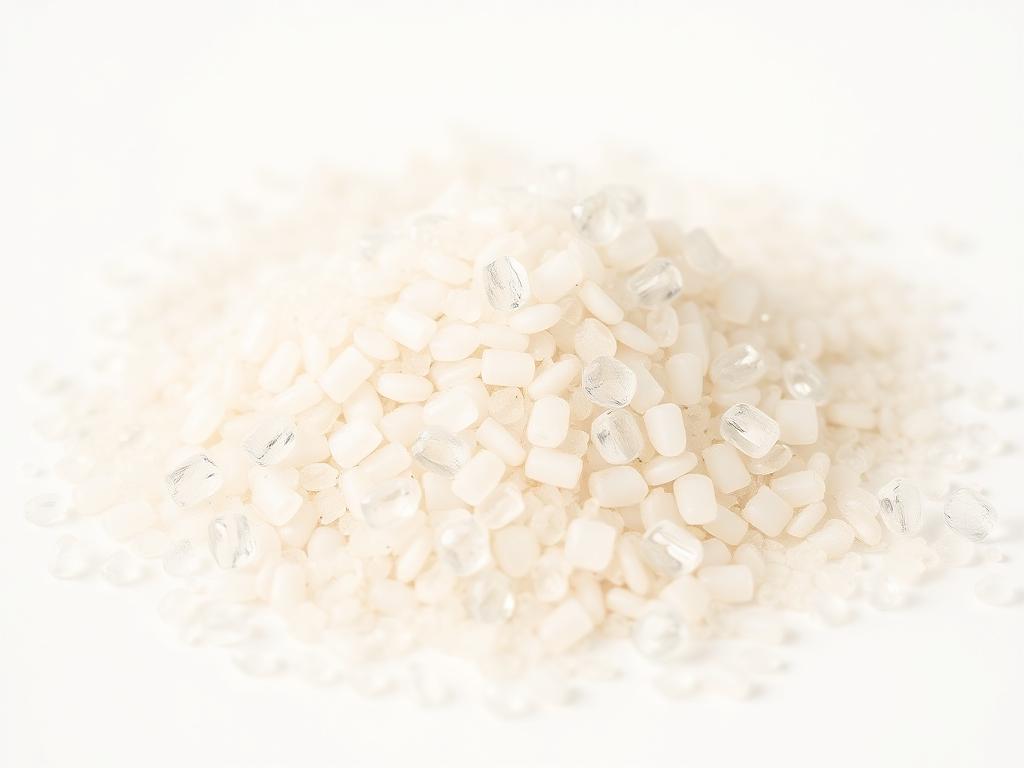
Polypropylene (PP)
Homopolymer, random and impact copolymer PP for moulding, film and fibre.
Indicative HS heading: 3902.10
Prices are quoted per enquiry. Availability, origin and certification are confirmed per shipment.
Product overview
Polypropylene divides into three families that solve three different problems. Homopolymer is the stiffest and highest in heat resistance, and it is what you want for rigid injection-moulded parts, BOPP film and fibre. Random copolymer trades some stiffness for clarity and a lower melting point, which is why it appears in transparent containers and in pipe systems that need to be welded. Impact (block) copolymer adds an ethylene-propylene rubber phase for low-temperature toughness — automotive parts, crates and appliance housings.
Melt flow rate is the process selector. High MFR fills thin, complex mouldings and spins fine fibre; low MFR gives toughness and melt strength for extrusion and thermoforming. Selecting by MFR alone, without naming the family, produces resin that flows correctly and then cracks in service at low temperature.
PP is also more sensitive to UV and oxidative degradation than PE, so outdoor and high-temperature parts need a stabilised grade rather than a stabiliser added at the machine as an afterthought.
Canadian supply context
Polypropylene is produced in Canada as part of the same petrochemical base that supports polyethylene, with capacity in Alberta and Ontario, and it forms part of Canada's industrial resin export flow.
As with PE, the availability conversation is grade-by-grade and window-by-window. We confirm what can actually be shipped rather than quoting a family in the abstract.
Types, grades and variants
All variants of Polypropylene (PP) are supplied from this single product record — there is no separate page or separate specification to chase.
PP homopolymer — injection
Rigid parts, closures and housewares; highest stiffness.
PP homopolymer — BOPP film
Biaxially oriented film for packaging and lamination.
PP homopolymer — fibre and raffia
Spinning, woven sacks and nonwoven feedstock.
PP random copolymer
Clarity and weldability; transparent containers and pipe systems.
PP impact copolymer
Low-temperature toughness for automotive, crates and appliances.
Thermoforming grades
Higher melt strength for sheet and formed packaging.
Key specifications
Indicative ranges for the commodity. Lot values are confirmed on the certificate of analysis for each shipment.
- Melt flow rate
- Selected to the process; stated per grade on the producer datasheet
- Family
- Homopolymer, random copolymer or impact copolymer
- Stabilisation
- Antioxidant and UV package specified for the service environment
- Form
- Pellets / granules
- Quality documentation
- Producer datasheet and certificate of analysis per lot
Applications
- Injection-moulded closures, crates and housewares
- Automotive interior and under-hood components
- BOPP and cast film for packaging
- Fibre, raffia and woven sacks
- Nonwoven fabric feedstock
- Thermoformed sheet and rigid packaging
Packaging & supply options
- 25 kg polypropylene bags, palletised and stretch-wrapped
- 1,000 kg / 1,250 kg bulk bags
- Full container loads; bulk options on confirmed volume
Export & commercial notes
- Name the family and the MFR together — one without the other is not a specification.
- For outdoor or hot-fill service, confirm the required stabilisation level in the enquiry.
- Quoted FOB, CFR or CIF.
Documentation
Commonly relevant documents. Availability is confirmed per order and destination.
- Producer technical datasheet
- Certificate of Analysis per lot
- Safety Data Sheet
- Certificate of Origin
- Food-contact compliance statement where applicable
Related industries
Ready to price Polypropylene (PP)?
Send the specification you already have — even a single line is enough to start. Attach a previous datasheet, tender document or purchase specification if you have one.